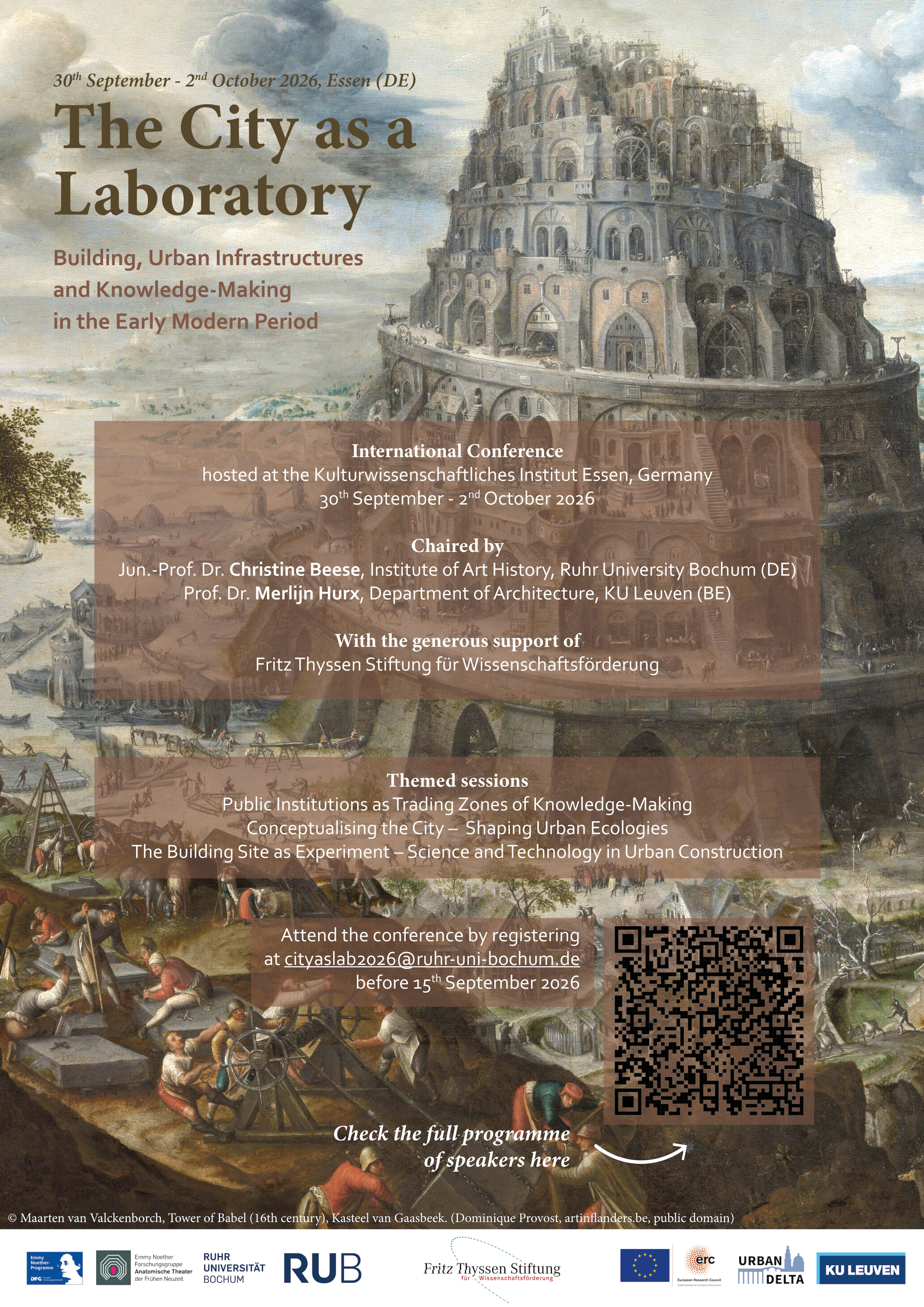
The City as a Laboratory – Building, Urban Infrastructures and Knowledge-Making in the Early Modern Period
Kulturwissenschaftliches Institut Essen (KWI)
Goethestraße 31, 45128 Essen
Organisers: Christine Beese (Ruhr-Universität Bochum) and Merlijn Hurx (KU Leuven)
Registration and organisational enquiries: cityaslab2026@ruhr-uni-bochum.de
With the generous support of Fritz Thyssen Stiftung.
Today, cities and metropolitan areas have emerged as leading hubs of innovation across the globe, driven by favourable ecosystems that combine high concentrations of tech enterprises, universities, and capital. This dominance has deep historical roots, reaching back to the late medieval and early modern periods, when cities began to function as experimental laboratories. Urban centres served as so-called trading zones where actors from diverse backgrounds actively engaged in creating, implementing, and disseminating knowledge to shape and advance urban conditions. From scientists to craftspeople, from the church to the courts, people with different institutional, social, and cultural backgrounds contributed to the formation of an urban body that was constituted by and continually reshaped through their knowledge-making.
The conference aims to shed light on the city as a contact zone and as both a subject and an object of knowledge-making. We situate architecture and civil engineering within a broader field of knowledge production in order to explore the paths and conditions of technological and cultural change.
Programme:
30.09.2026 Wednesday
Welcome and Introduction
09:30–10:15 Christine Beese (Bochum, Germany) and Merlijn Hurx (Leuven, Belgium)
Session: Public Institutions as Trading Zones of Knowledge-Making
10:15–11:00 Nicole Falconi (Bochum, Germany): Constructing Anatomical Theatres in Ibero-American Hospitals: Surgeons, Architects and Craftsmen as Collaborators in the 18th and 19th Centuries
11:00–11:15 Coffee Break
11:15–12:00 Giedrė Jarulaitienė (Drammen, Norway): Johan Daniel Berlin: Architect of the Enlightenment City
12:00–12:45 Sebastian Fitzner (Bochum, Germany): Scaling the City – Architectural Models as Knowledge Repositories in the Early Modern Period
12:45–13:45 Lunch
Session: Conceptualising the City
13:45–14:30 Marc Nötges (Kaiserslautern, Germany): Imagined Cities, Model Worlds: Architectural Capricci as Pictorial Models
14:30–15:15 Pedro Gonçalves (Paris, France): Pierre Patte’s Organic Vision of the City
15:15–15:30 Coffee Break
15:30–16:15 Caroline Fußbach Parussel and Maurice Parussel (Bochum, Germany): The City Book ‘Civitates Orbis Terrarum’ Between Geography and Chorography
16:15–17:00 Marie Krüger (Bochum, Germany): Shaping the City of Knowledge: The Leiden University Print Series
Keynote
17:15–18:45 Bert De Munck (Antwerp, Belgium): Crafting the Urban Body Politic: The Epistemological Foundations of the Early Modern City
01.10.2026 Thursday
Session: Shaping Urban Ecologies
09:30–10:15 Davide Martino (Brussels, Belgium): Designing a Flood-Proof City in the Early Modern Dutch World
10:15–11:00 Fatma Sarıkaya-Işık (Ankara, Turkey): Measured Waters: Water Infrastructure and Urban Knowledge in Early Modern Istanbul
11:00–11:15 Coffee Break
11:15–12:00 Ludovica Galeazzo (Padua, Italy): Building and Governing a Watery Periphery: The Venetian Lagoon Archipelago in the Early Modern Period
Session: The Building Site as Experiment
12:00–12:45 Emma Bekaert (Leuven, Belgium): From Galley to Ground: The Venetian Arsenal and the Development of Early Modern Foundation Expertise
12:45–13:45 Lunch
13:45–14:30 Vincent Vanhamme (Leuven, Belgium): Searching for Knowledge: Governing the Construction of the Sixteenth-Century Sassevaart
14:30–15:15 Nicoletta Marconi (Rome, Italy): Building in Rome Between the 17th and 19th Centuries: A Crossroads of Practices, Technical Experimentation, and Dissemination of Knowledge
15:15–15:30 Coffee Break
15:30–16:15 Elizabeth Deans (Cambridge, England): Wren’s Architectural Intelligence and the Rationalisation of the Louvre Building Site
16:15–17:00 Anna-Luna Post (Leiden, The Netherlands): Cities, Essay Prizes, and Academies in the Eighteenth-Century Dutch Republic
02.10.2026 Friday
Session: Science and Technology in Urban Construction
09:30–10:15 Cristiano Guarneri and Ines Ivić (Venice, Italy): Circulation of Architectural Knowledge in Ragusa (Dubrovnik) After the Great Earthquake of 1667
10:15–11:00 Charles van den Heuvel (Amsterdam, The Netherlands): Mechanics Mosaics: Interwoven Knowledge of Engineering in the Low Countries (ca. 1570–1670)
11:00–11:45 Karel Davids (Amsterdam, The Netherlands): The Limits of Innovations: Urban Infrastructures in Early Modern Amsterdam Compared with Other European Cities
11:45–12:30 Final Discussion
14:00–16:00 Guided Tour of Salvator Church in Duisburg and Visit to the Duisburg City Museum


